
Having spent over a decade talking about little else, anyone who knows me knows that when it comes to the spirit I prefer most, it’s whiskey, and American whiskey, at that. The flavours, the stories, the history, the experiences, and the people I have met along the way are what have kept me driven in this space, not to mention the incredible pours I have had the pleasure of sipping over the years! I did not start with American whiskey, though. Originally, like my father and my grandfather before him, I saw myself as a Scotch drinker when I first started out. For over a year, I looked high and low on a shoestring budget to find a style of single malt I actually liked. Then one day, I stumbled across a bottle of Wild Turkey 101 with an eight-year age statement sitting on a shelf and pure curiosity convinced me to buy it over the slightly more expensive bottle of Vat 69 next to it. That impulse brought me to where I am today. It taught me to stay curious about things I am not familiar with, to try anything at least once, and to follow my palate. If I do not like what something tastes like, there is zero reason to torture myself. Most recently, that exact curiosity caught up with me over Tequila.
Picture the scene. It is after 9pm on a warm summer evening in Dublin. A group of us working for Heaven Hill have just wrapped up our 4th four-hour session at Whiskey Live Dublin, pouring a wide range of bottles for the crowd. As we sat mulling over a cold pint, conversation drifted from what we had seen at the show to what was new on the market, and eventually turned toward Tequila Ocho in a very business-like sense. I had never tried Tequila Ocho. Up until that moment, Tequila occupied a tiny, dark corner in the back of my mind alongside vodka, white rum, and unaged new-make whiskey, A.K.A the firewater section. My limited experience with it was either buried under lime juice in a summer margarita or slammed back as a rough shot at the end of the night with salt. Hardly premium by any stretch of the imagination! Those at the table who had tried Ocho, however, held it in very high regard. They talked about the quality of the liquid, the struggle to meet global demand, and the logistics of producing a spirit where everything comes from a single field, harvested only when ready, naturally limited by what the highlands of Jalisco can yield in a given season. This combination had left them with not enough to sell eager customers in Europe and further afield, an understandable obstruction. Business aside, however, from how everyone described it, my interest was fully sparked and if it was as good neat as they all claimed, I would need to try it. However, if it was terrible, well, it would quickly become a large volume of margaritas. A win-win either way!
We left the pub tired that night, but my brain kept chewing on the conversation and so I resolved to hunt down a bottle. What followed was a string of messages, emails, a phone call or two, and a fair bit of favour-pulling, as Ocho wasn’t easy to find in Ireland,. But, by the time it was all sorted, I managed to get my hands on not just a bottle of Tequila Ocho Plata, but also the Reposado, both harvested from the exact same field in the same year. Success!
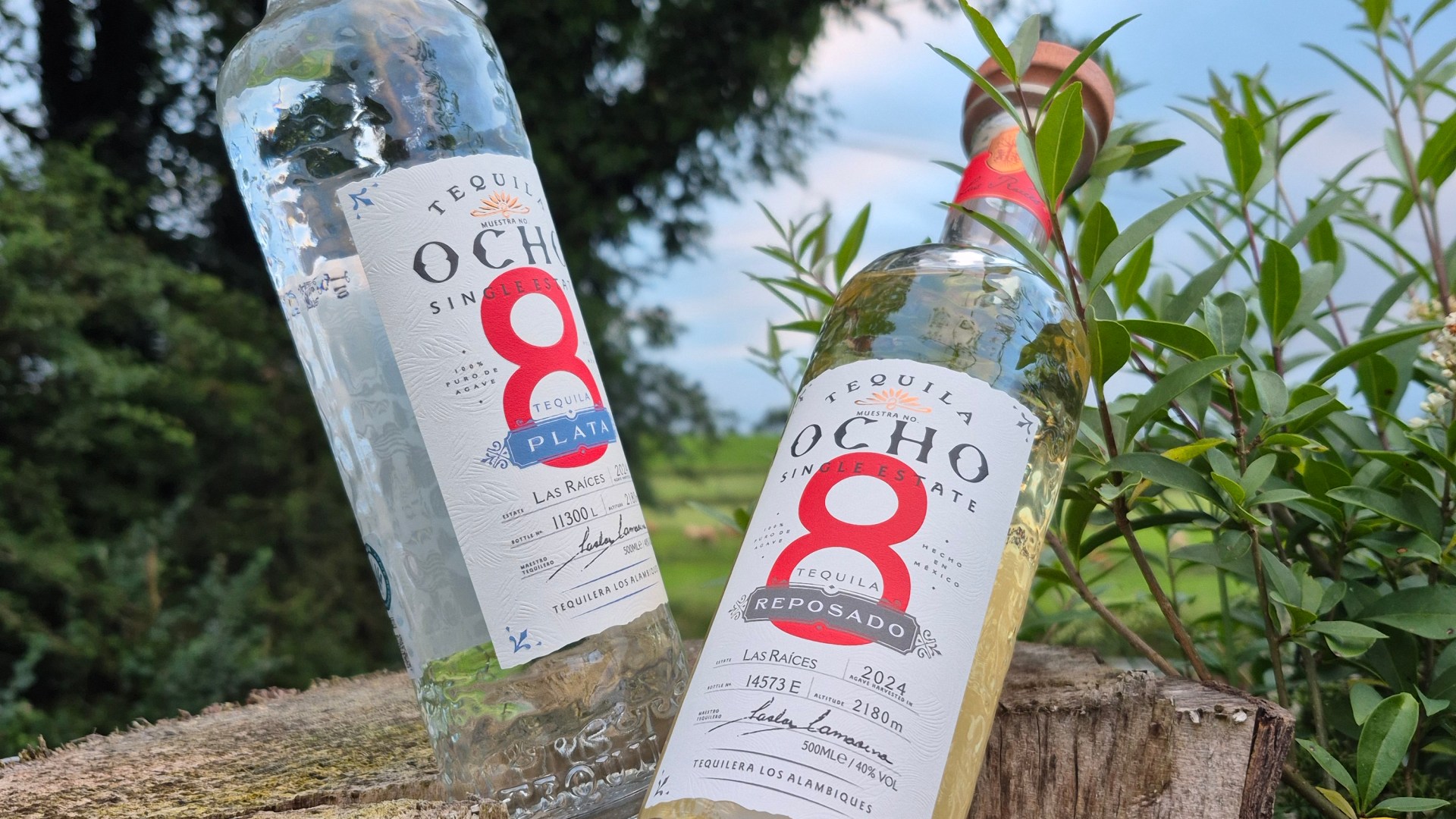
I unboxed them in my front garden in an Instagram reel, hesitantly announced I was dipping into tequila discovery, snapped a few photos of the sealed bottles, and unceremoniously popped the top on the Plata to pour a dram into a Glencairn glass waiting on standby.
Having by now tasted my fair share of new-make whiskey from around the world (including experimental Irish and American recipes, aged moonshines, and unaged corn spirit), I know what unaged spirit usually brings to the table. Whilst always very interesting from a production perspective, raw unaged grain spirit is rarely something you reach for twice. By that logic, the expectations were low, given that Tequila, in its unaged form, is essentially a new-make spirit that, unless it is aged or altered with additives, you get what comes directly off the stills with some added water. What greeted me in that Glencairn glass, however, had none of the harshness or aggressive bite I usually get from raw grain spirit. Instead (and to my surprise!), I found a complex and richly flavourful spirit that caught me completely off guard! Who knew premium tequila wasn’t a scam or a clever marketing trick?!?
So today we are going to talk about Tequila, and specifically Tequila Ocho. I am by no means an agave expert, but as always, I know what I like and what I do not. As such, I am approaching this the same way I have approached whiskey for the last ten years: with empirical attention to detail, side-by-side comparisons, a focus on structural weight, and blunt honesty. Now let’s get into the details of how this stuff is actually made!
Tequila 101-ish…
To understand why a brand like Tequila Ocho is so highly respected amongst Tequila purists, you first have to look at and understand what Tequila actually is under Mexican law.
If you ask the average drinker to define tequila, they will usually tell you it is a Mexican spirit distilled from a cactus. Both parts of that misunderstanding misses the mark. The agave plant is not a cactus; it’s technically a succulent belonging to the Asparagaceae family, and whilst Tequila is essentially Mexican, its legal boundaries, agricultural timelines, and production methods are governed by laws which are just as strictly as those governing the production of Bourbon, Rye, or Single Malt.
Where American whiskey drinkers look to the Standards of Identity or the Bottled-in-Bond Act of 1897 to guarantee spirit integrity and quality, Tequila is governed by the Norma Oficial Mexicana (NOM-006-SCFI-2012) and monitored by the Consejo Regulador del Tequila (CRT). To legally bear the name Tequilla, the spirit must be produced from 100% Blue Weber Agave (Agave tequilana Weber var. azul) which was grown, harvested, and distilled within five designated Mexican states: the entire state of Jalisco, and specific municipalities in Guanajuato, Michoacán, Nayarit, and Tamaulipas. If it is made anywhere else, or from any other plant species, it is not Tequila.
Agave Spirits vs. Tequila vs. Mezcal
Think of “Agave Spirits” as the umbrella category, much like “Whisk(e)y” describes Bourbon, Scotch, Rye, Japanese, Indian and Irish, etc. whiskies:
- Mezcal is one type of agave spirit that can be produced from over 30 distinct species of agave across ten Mexican states. Here, the agave piñas are traditionally pit-roasted in underground stone pits lined with wood and charcoal, imparting mezcal’s signature smoky profile.
- Tequila is a strictly regulated sub-category of mezcal. It must be made exclusively from Blue Weber Agave, and the piñas are steam-cooked in ovens or pressurized autoclaves rather than roasted underground. This preserves a bright, vegetal, naturally sweet, and un-smoky spirit profile.
Grain vs. Succulent
The most striking distinction between whiskey and tequila production sits out in the fields. In whiskey, corn, rye, or barley crops require a single growing season (a matter of months) to become harvest-ready. If there’s a poor harvest or disease issues, the distillers simply source their grain from elsewhere. Agave does not play by the same seasonal rules. A Blue Weber agave plant takes anywhere from 6-10 years to reach full maturity. During those years, the plant grows, absorbs the mineral profile of the local soil, endures years of weather variation, and stores complex fructans sugars in its central bulb, known as the piña.
Mexico is home to various types of terrain, soil-types, and seasonal effects, meaning where that agave grows geographically heavily dictates the final flavour profile as all these factors and more impact the growth of the plant and the minerals available it as it grows. In Jalisco where most of the agave for tequila is grown, the geography is broadly divided into two main growing environments:
The Highlands (Los Altos): Featuring high elevation, iron-rich red clay soil, and cooler nights, meaning agave growing here accumulate higher sugar levels, yielding sweeter, fruitier, and more floral spirits.
The Lowlands/Valleys (El Valle): Featuring more volcanic-type soil and warmer weather, meaning agave growing here produce spirits with earthier, more herbal, and bold black pepper characteristics.
Harvesting is dictated by the sugar density of the individual agave plant, measured in Brix. When a jimador uses a razor-sharp coa to trim the spiky leaves away from the 50 to 100-pound piña, that plant is removed from the earth and is done. You cannot re-harvest an agave plant the following year, it’s one time use only. Therefore, every batch of tequila represents a raw agricultural investment that took nearly a decade of growth before a copper still was even considered.
The Production Process
Unlike grain crops that grow in a single season, Blue Weber Agave requires 6 to 10 years of continuous growth in Jalisco to reach full maturity, absorbing sunlight, rain, and soil minerals to build up dense starches (inulin – the long-chain plant starches stored in the agave core). Harvest timing is dictated by sugar density, measured in Brix – a scientific scale used to measure the percentage of sugar dissolved in plant liquid. A skilled field worker called a jimador, who harvests agave by hand, tests the plant to ensure it has reached peak sugar levels before slicing away the outer leaves using a coa (a razor-sharp, flat, circular steel blade on a wooden handle) to reveal the 50-to-100-pound heart of the plant, the piña (named for its visual resemblance to a giant pineapple).
Once the piñas leave the field, tequila production mirrors the fundamental steps of craft whiskey making:
- Cooking: In whiskey, hot water and enzymes convert grain starches into fermentable sugars. In tequila, whole piñas are cooked to convert complex fructans sugars into simple sugars. Traditional brick steam ovens used for slow baking called hornos bake piñas slowly over 24 to 72 hours, gently caramelising the piñas and preserving its natural flavours.
- Extraction & Milling: The cooked, softened piñas are then crushed using either a traditional volcanic stone wheel called a tahona which is rolled over cooked agave to crush fibers and release juice, or mechanical roller mills to extract the sweet unfermented agave juice called aguamiel, which literally translates to “honey water.”
- Fermentation: This sweet agave juice ferments in open wooden or stainless steel vats where yeast converts the sugars into a low-proof agave wash.
- Distillation: The wash undergoes two separate runs through copper pot stills. The first run yields a low-proof distillate called ordinario (the low-proof spirit from the first distillation, around 20 to 25% ABV). The second run refines it into Tequila Blanco, coming off the copper stills between 55% and 60% ABV (110 to 120 proof) before being proofed down with water for bottling or barrelling.
The Industrial Traps
When you understand the patience required for traditional agave craft, it becomes easy to see how producers fall into operational traps when trying to bypass these stages for profit or efficiency. Agave is a long-term agricultural commitment. Waiting up to a decade for a single crop means that when global demand spikes or agave prices climb, a producer cannot simply order another shipment of grain or run an extra mash build next week. They are bound entirely by what was planted a decade ago. As such, when supplies run tight, large-scale production often fractures into shortcuts designed to stretch yield and cut time. Some examples include:
- Fast-cooking shortcuts & using diffusers: To bypass slow brick-oven baking, some industrial operations use high-pressure industrial steam cookers called autoclaves to force cooking down to under 12 hours. The ultimate shortcut here, however, is a chemical diffuser (an industrial machine that shreds raw, unbaked agave and washes it with hot water and acid to extract starches without traditional cooking). Diffusers strip away natural agave character entirely, producing the tequila equivalent of distilling grain up to 190-proof neutral spirit.
- Over-oaking the spirit to cover distillate flaws: When a spirit has been stripped or rushed through distillation, heavy barrel char, wet wood, or artificial oak extracts are often used during aging to bury the base distillate. If a rested tequila tastes exclusively like wet oak, caramel, and vanilla with zero agave character left, the barrel isn’t complementing the spirit, it’s hiding a flawed product.
Legal Classifications
Once clean distillation is finished, tequila is sorted into classifications governed by Mexico’s CRT (Consejo Regulador del Tequila), the legal governing body enforcing tequila production standards. These are:
- Blanco / Plata (i.e., unaged): Bottled straight after distillation or rested for under 60 days in stainless steel or neutral oak. This is pure distillation character with zero oak masking.
- Reposado (i.e., rested): The Tequila is matured in oak containers for a minimum of 2 months up to 1 year.
- Añejo (i.e., aged): The Tequila is matured for at least 1 year in government-sealed oak barrels with a maximum capacity of 600 litres.
- Extra Añejo (i.e., extra aged): The Tequila is matured for a minimum of 3 full years in small oak casks.
Most aged tequila ages in second-fill American oak barrels previously used for Bourbon or Tennessee Whiskey, and because ambient temperatures in Mexico are so high, barrel interaction happens rapidly compared to cooler maturation climates.
The Additive Reality
This brings us to the biggest trap in the tequila category, and the main reason so many whiskey drinkers get burnt early on. Under official Mexican regulations, a bottle labelled “100% Agave” guarantees that all fermentable sugars came from Blue Weber Agave (unlike cheap Mixto which is a tequila made with a mixture of agave and up to 49% non-agave sugars like corn or cane syrup). However, Mexican law contains a controversial loophole. Tequila producers are legally permitted to include up to 1% by total weight of additives, known as abocantes, without declaring them anywhere on the label.
When a spirit has been stripped of its natural character during hyper-industrial extraction or rushed distillation, it often comes off the stills tasting thin, sharp, or flat. To make it palatable for a mass market, producers turn to these four permitted additives:
- Glycerine: Added to create a synthetic, oily mouthfeel and fix thin texture.
- Caramel Colour: Used to make young, lightly rested tequilas look old and dark.
- Oak Extract & Mellowing Agents: Used to fake long wood maturation notes.
- Sugar Syrups (Jarabe): Used to sweeten the spirit and hide harsh, poorly distilled ethanol edges.
Although 1% by total weight sounds small on paper, in concentrated chemical form it completely alters a spirit, turning a harsh distillate into a sugary pour that smells like artificial vanilla cake batter. For whiskey drinkers who expect unadulterated spirit integrity, seeking out confirmed additive-free tequila is the equivalent of insisting on Bottled-in-Bond or single barrel whiskies. It guarantees that every note of fruit, pepper, earth, and wood in your glass came naturally from mature agave, clean copper distillation, and authentic barrel time without relying on laboratory dosing to fix what should have been done right in the field and at the still.
Which brings us directly to Tequila Ocho!
Tequila Ocho: Terroir, Philosophy, & Las Raíces
Once you get past basic tequila classifications, you quickly realise that most commercial tequila brands aim for absolute consistency across batches. They blend liquid harvested from multiple fields, age it in massive oak inventories, and rely on permitted additives to ensure every bottle tastes identical year after year. Tequila Ocho, however, was created as an intentional push back against this industrial mindset. Tequila Ocho is the result of a partnership between two influential figures in the spirits world: Carlos Camarena, a fifth-generation agave farmer and third-generation master distiller based in Arandas, Jalisco (whose family is considered royalty in Mexican distilling, known for producing spirits at the La Alteña distillery, home of El Tesoro and Tapatío), and the late tequila ambassador Tomas Estes, a restaurateur and author who spent decades educating Europe and North America on authentic, additive-free agave spirits. When they created Tequila Ocho in 2008, their goal was not to produce a smooth, mass-appeal crowd-pleaser. Instead, they set out to prove that terroir exists in tequila, much like it does in wine.
As whiskey drinkers, we understand how altering a mashbill, changing a yeast strain, or shifting barrel entry proof completely changes the resulting whiskey. Ocho takes the exact opposite approach. To prove that the land itself dictates the final Tequila character and flavour, Ocho holds every other production variable as constant as possible. For all their Tequila, they use:
- The same 100% Blue Weber Agave.
- The same proprietary house yeast culture.
- The same processes of slow-cooking in traditional brick ovens, open-vat wooden fermentation, and double copper pot distillation at their distillery (NOM 1474).
When you keep the plant, the yeast, and the equipment the same across batches, there is only one variable left to manipulate: where the agave grows geographically.
Some of their fields are carved out of shallow, rocky slopes with poor water retention; others sit on flat plains with deep, volcanic soil or iron-rich red earth. Combine that soil variation with elevation shifts ranging from 5,000 to over 7,000 feet above sea level, and the raw agave develops entirely different sugar structures and mineral profiles as it adapts to survive a decade under these conditions.
In an unaged spirit like a Plata, where there is zero wood to hide behind, those who champion single-field agave argue that the concept of terroir becomes nearly irrefutable. They claim, for example, that you can line up two bottles of Ocho Plata produced on the exact same copper stills with the exact same yeast, and they will taste distinctly different purely because one batch grew in rocky soil at a lower altitude while the other sat in iron-rich clay over a thousand feet higher. Objectively, the logic makes sense: if a plant sits in the ground for close to a decade absorbing specific soil minerals, rainfall, and elevation shifts, it ought to reflect that environment in the glass. However, as someone coming into this fresh from the whiskey world, that was the big claim I wanted to test for myself (more on this later!). To make this even more explicit, every bottle of Tequila Ocho transparently prints these exact variables on the front label: the harvest year (vintage), the specific field name (rancho), and the exact elevation of that field.
The Tequila Ocho Range Review
Having laid down the agricultural foundations, the production realities, and the philosophy behind single-field agave, it is time to put liquid to glass. The three bottles I am breaking down in this review all come from the 2024 vintage harvest of a single field named Rancho Las Raíces (“The Roots”). Sitting at an elevation of 2,178 metres (7,145 feet) above sea level high in the Jalisco Highlands, Las Raíces is described as a gentle, south-sloping hill located under eight kilometres from Destilería Los Alambiques. The soil here is classic Los Altos red clay, which is rich in iron and potassium, and divided by a small grove of ash, oak, and poplar trees. Given the extreme high altitude, full southern sun exposure, and mineral-dense soil, the agave harvested here in 2024 were reported to have reached an extraordinarily high sugar content around 32% brix (compared to the 20% to 24% brix common in standard commercial harvests). This higher raw sugar density in the piña translates directly into richer fermentable fructose, which directly impacts the base spirit off the copper pot stills.
As every drop of spirit in these three expressions came from Las Raíces piñas harvested in 2024, we get a clean baseline to evaluate how unaged spirit (Plata), short barrel resting (Reposado), and custom barrel finishing (Old Fitzgerald Añejo) perform when built on the exact same agricultural foundation.
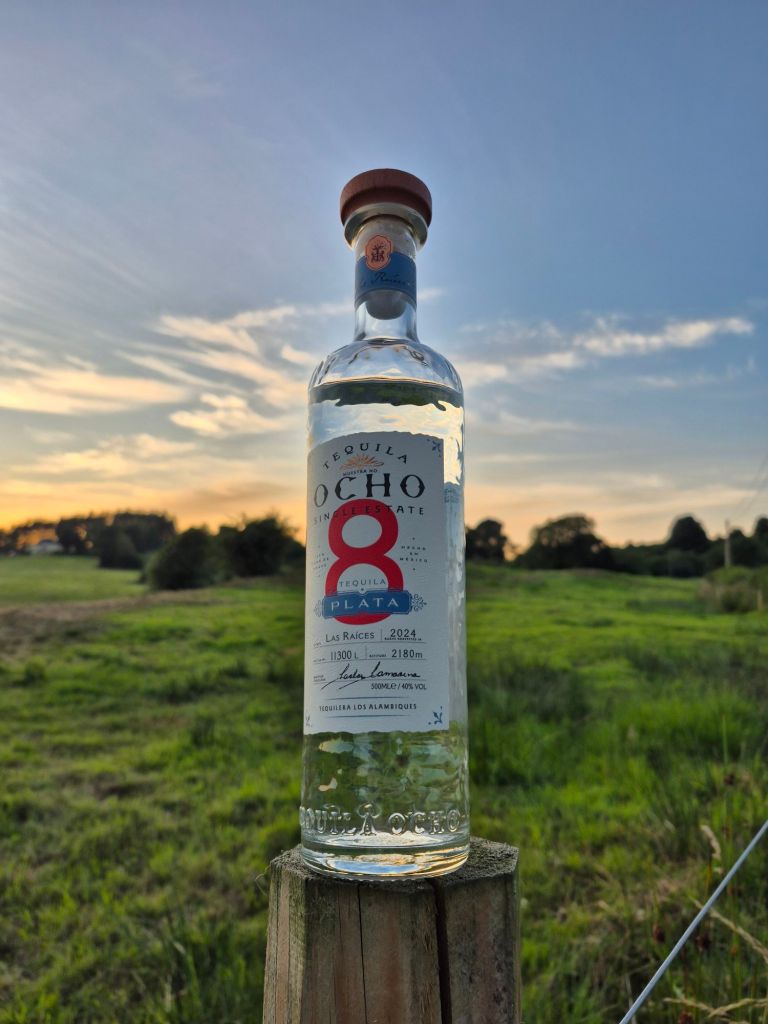
Tequila Ocho Plata
Vital Stats:
- Field & Vintage: Rancho Las Raíces (2024 Harvest)
- Elevation: 2,180 metres (7,152 feet) above sea level
- Maturation: Unaged (Rested briefly in neutral stainless steel vats)
- ABV / Proof: 40% ABV (80 Proof)
- Distillation: Double Copper Pot Still
Notes
- Nose: Toasted agave, fresh lime, and black pepper, backed by gentle smoke, a touch of vanilla, and natural sweetness.
- Palate: Oily and full-bodied, opening with bright citrus before moving into green bell pepper, white pepper, and a wonderfully distinctive sweet agave character. As you chew, subtle smokiness emerges alongside a touch of salinity, black pepper, and a slight herbal character. Everything feels balanced throughout without any sharp or aggressive notes jumping out.
- Finish: Lingering agave, herbal notes, black pepper, and lime notes with a long aftertaste.
Overall
Sipping this, it’s difficult to imagine that this is essentially a new-make spirit where the only addition after distillation is water. What strikes me most is just how expressive and flavourful it is. I’ve spent years thinking of tequila as a one-dimensional spirit, and with one taste, Ocho has proven that assumption completely wrong, showing me a spectrum of flavours I hadn’t thought possible from an unaged pour.
It manages to be both balanced and raw in its profile, giving you a delicious, complex spirit that keeps its direct connection to the earth while remaining far too easy to drink neat. I shared this with another whiskey friend who has a sharp palate; his immediate reaction was that it tasted like a premium margarita in a glass, completely surpassing his expectations for what a tequila could deliver.
At 40% ABV, you’d also be forgiven for expecting it to feel thin on the tongue, but it is everything but thin. I have since learned that 40% ABV isn’t even the lowest proof tequila is legally allowed to go, just the lowest proof I personally care to go! It’s stunning, complex, and flavourful. This is the exact bottle that convinced me to continue on this discovery journey through Tequila and agave spirits.
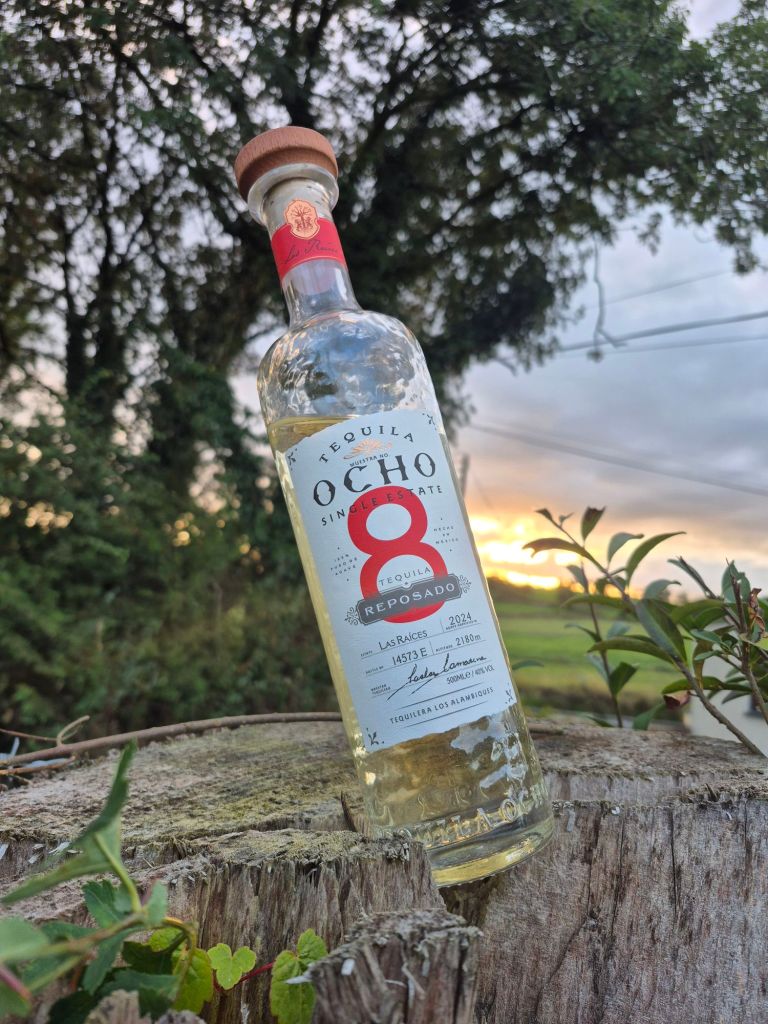
Tequila Ocho Reposado
Vital Stats:
- Field & Vintage: Rancho Las Raíces (2024 Harvest)
- Elevation: 2,180 metres (7,152 feet) above sea level
- Maturation: Aged in second-fill American oak barrels (ex-bourbon) for roughly 8 to 12 weeks
- ABV / Proof: 40% ABV (80 Proof)
- Distillation: Double Copper Pot Still
Notes
- Nose: The nose opens with toasted agave that feels instantly familiar after the Plata, but here it carries a softer, vanilla-edged smoke. Citrus jumps from the glass with more intensity than the Plata, adding a bright lift to the aroma alongside subtle oak, smokiness, and a herbal edge.
- Palate: Viscous on the tongue, starting with creamy vanilla before shifting into sweet toasted agave and subtle notes of citrus, caramel, and smoky black pepper. The vanilla keeps the sharper notes in check at first, but once you chew the spirit, the citrus and pepper begin to push through, creating a warm bite through the mid-palate that feels layered and lively.
- Finish: The finish lingers with pepper and citrus while the toasted agave turns herbaceous and green. It settles into a long aftertaste that keeps unfolding.
Overall
Sipped side-by-side next to the Plata, the barrel influence here is surprisingly restrained. The vanilla is more obvious than on the Plata, while the citrus feels slightly more subdued than it did on the nose. Yet, the core DNA of the Plata shines through unimpeded. The Reposado feels rounder, softer, and more complex on the tongue, bringing extra creaminess, subtle caramel, and a faint herbaceous edge into play, but it never forgets it came from an agave field. With enough chewing and swishing, you can trace the exact journey from raw agave brightness to this deeper, warmer profile.
That balance is, to my understanding, entirely by design. To understand what Ocho is doing with their Reposado, you have to look at how they approach oak maturation as a whole. While the CRT legally requires a Reposado to rest in oak for a minimum of two months (60 days), many commercial producers take a heavily charred barrel, age their liquid up to eleven months, or use additives to force a dark, sweet, heavily oaked profile. Ocho takes the exact opposite approach. Their core aim is not to transform Tequila into a whiskey surrogate, but to let the wood act as a quiet supporting player.
As such, Ocho age their Reposado for the absolute minimum necessary time, resting it for roughly eight weeks and eight days in well-used, re-pass American oak ex-bourbon barrels. The goal throughout is simple: preserve the raw field character of the agave, using the barrel merely to round off sharp ethanol edges, add a gentle touch of micro-oxygenation, and introduce a whisper of vanilla sweetness without obscuring the plant’s character. Ocho’s Reposado tastes like an intentional bridge that demonstrates how minimal wood contact can soften a vibrant, raw spirit without burying its sense of place.
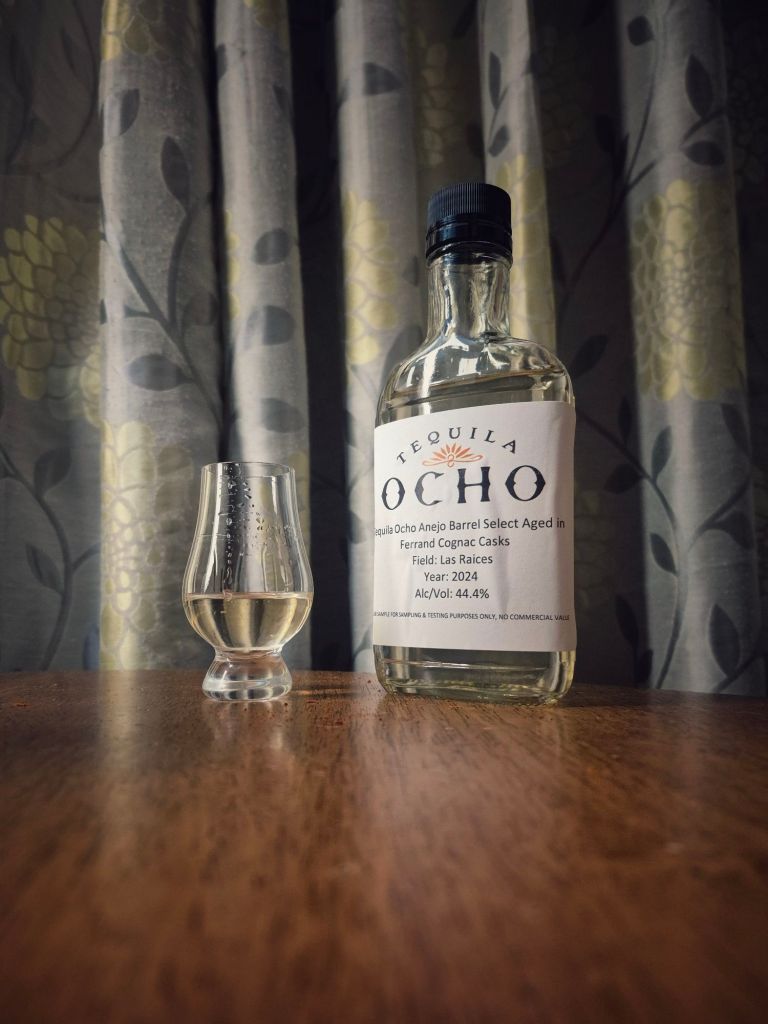
Tequila Ocho Añejo Barrel Select – Old Fitzgerald Casks
Vital Stats
- Field & Vintage: Rancho Las Raíces (2024 Harvest)
- Elevation: 2,180 metres (7,152 feet) above sea level
- Maturation: Aged 12 months in secondary American oak barrels previously holding Old Fitzgerald Bottled-in-Bond Wheated Bourbon
- ABV / Proof: 48% ABV (96 Proof)
- Distillation: Double Copper Pot Still
Notes
- Nose: It opens all business, no longer as sweet or floral as the Plata or Reposado. Concentrated aromas of toasted agave, green bell pepper, smoky oak, and a dry herbal edge come through first, surrounded by fresh lime, black pepper, baking spices, rich vanilla, and a faint note of dried red fruits.
- Palate: The entry opens herbaceous and sweet, but more in a soft wheated bourbon sense than a toasted agave sense. Initial notes of caramel, a flash of sweet red fruit, and herbaceous oak coat the tongue before the toasted agave fights its way back to the front, bringing zesty lime, bold vanilla, smoky oak, and black pepper spice with it. As you keep chewing, you pick up initial bourbon barrel notes of dark chocolate and herbaceous oak before they fade, leaving behind a concentrated core of raw agave: toasted plant, green bell peppers, black pepper, citrus, and a herbal edge.
- Finish: Opens with herbaceous toasted agave, bright citrus, pepper, and a long, warming oak aftertaste.
Overall
Of the three expressions, this was by far the strangest, most complex, and most intriguing pour of the lot. The Old Fitzgerald profile is one I am intimately familiar with. It is my personal favourite wheated bourbon thanks to its soft, approachable delivery, complete lack of sharp edges, and fruit-forward depth. Coming into this pour at 48% ABV (96 proof), we are already in for a bigger, punchier tequila experience right out of the gate. What makes this bottle fascinating is that it brings two distinct worlds together in a way where both spirits get their moment to shine without drowning each other out. The end result is a concentrated tequila profile rounded out by the red fruit and soft, herbaceous oak characteristics of a legendary wheated bourbon cask. Having tasted plenty of Old Fitz, that soft red fruit and herbaceous oak footprint is unmistakable here.
Unlike the Reposado, this isn’t as viscous on the tongue, carrying a drier, more tannic mouthfeel. Savouring it neat reminded me of an experiment I ran about a decade ago, where I toasted my own Irish oak staves in a kitchen oven before charring them over an open flame to a level five char and infusing them into a cheap bourbon. The result was a bourbon with a heavy campfire oak and charred wood. While this Ocho release does not reach that same acrid level, it carries distinct glimmers of that dark, toasted barrel char coming through alongside a clean agave base.
Most surprisingly, returning to this glass actually unlocked the entire lineup for me. The oak character in this Añejo brought out a subtle toasted coconut note in the Reposado that I hadn’t picked up on during my first pass. For a whiskey drinker, this bottle bridges the gap between Kentucky and Jalisco in a way that respects both traditions.
Final Thoughts
Stepping out of my comfort zone as a whiskey drinker is always a bit of a gamble and has often yielded mixed results, even within whiskey itself (sorry Irish!). When you’ve spent years building your palate around heavily charred oak, grain-forward distillate, and high-proof American whiskey, it’s easy to assume everything outside that circle will feel like a compromise. Tasting through the Tequila Ocho Las Raíces 2024 lineup proved that assumption completely wrong.
If you, like me, are a bourbon or whiskey drinker sitting on the fence about additive-free tequila, here is what this deep dive has boiled down to:
- Unaged spirit isn’t always “firewater”: In the whiskey world, raw new-make is rarely something you reach for neat. The Ocho Plata completely shattered that expectation. When agave is grown to full maturity and distilled cleanly in copper pot stills without shortcuts, unaged spirit can be every bit as expressive and complex as a mature whiskey.
- Oak should complement, not cover: Coming from bourbon, we’re used to barrels driving much of the flavour profile. Ocho’s Reposado and Old Fitzgerald Barrel Select demonstrate how wood can act as a supporting player rather than the star of the show, enhancing the spirit without obscuring its origins.
- Additive-free matters: Just as many whiskey drinkers seek out Bottled-in-Bond, non-chill filtered, or naturally coloured whiskey, additive-free tequila provides confidence that what’s in the glass came from the field, the still, and the barrel rather than a laboratory.
- Terroir is real: The idea of single-field vintage releases initially sounded almost too neat to be true. After tasting these expressions side-by-side, I’m far more convinced that place matters. Whether it’s the soil, elevation, climate, or a combination of all three, the connection between agricultural origin and final flavour feels impossible to ignore.
What surprised me most wasn’t that I enjoyed Tequila Ocho, it was discovering just how wrong I had been about tequila as a category in the first place. For years, I dismissed tequila as little more than a vehicle for margaritas, late-night shots, and supermarket shelf gimmickry. In hindsight, that was a lazy assumption coming from limited experience rather than informed opinion. Had I applied that same logic to whiskey, I would never have discovered bourbon in the first place. After all, if I’d judged the entire whiskey category by my first disappointing bottle, I’d never have picked up that bottle of Wild Turkey 101 all those years ago, and none of this would exist.
Tequila Ocho has reminded me of an important lesson that I apparently need to keep relearning: follow your palate, not your preconceptions. So whilst American whiskey remains firmly my first love, agave has absolutely earned its place on my shelf and in my glass. More importantly, this bottle has opened the door to an entirely new category that I am genuinely excited to explore. If you’ve been following along for bourbon content and wondering why a tequila review suddenly appeared on your feed, don’t worry, I’m not abandoning Kentucky anytime soon. But I am going to keep pulling on this thread. There is clearly far more depth, nuance, and craftsmanship in agave spirits than I ever gave them credit for. So consider this your warning: there will almost certainly be more tequila, more agave, and probably a few mezcals appearing here in the months ahead.
Watch this space…


