
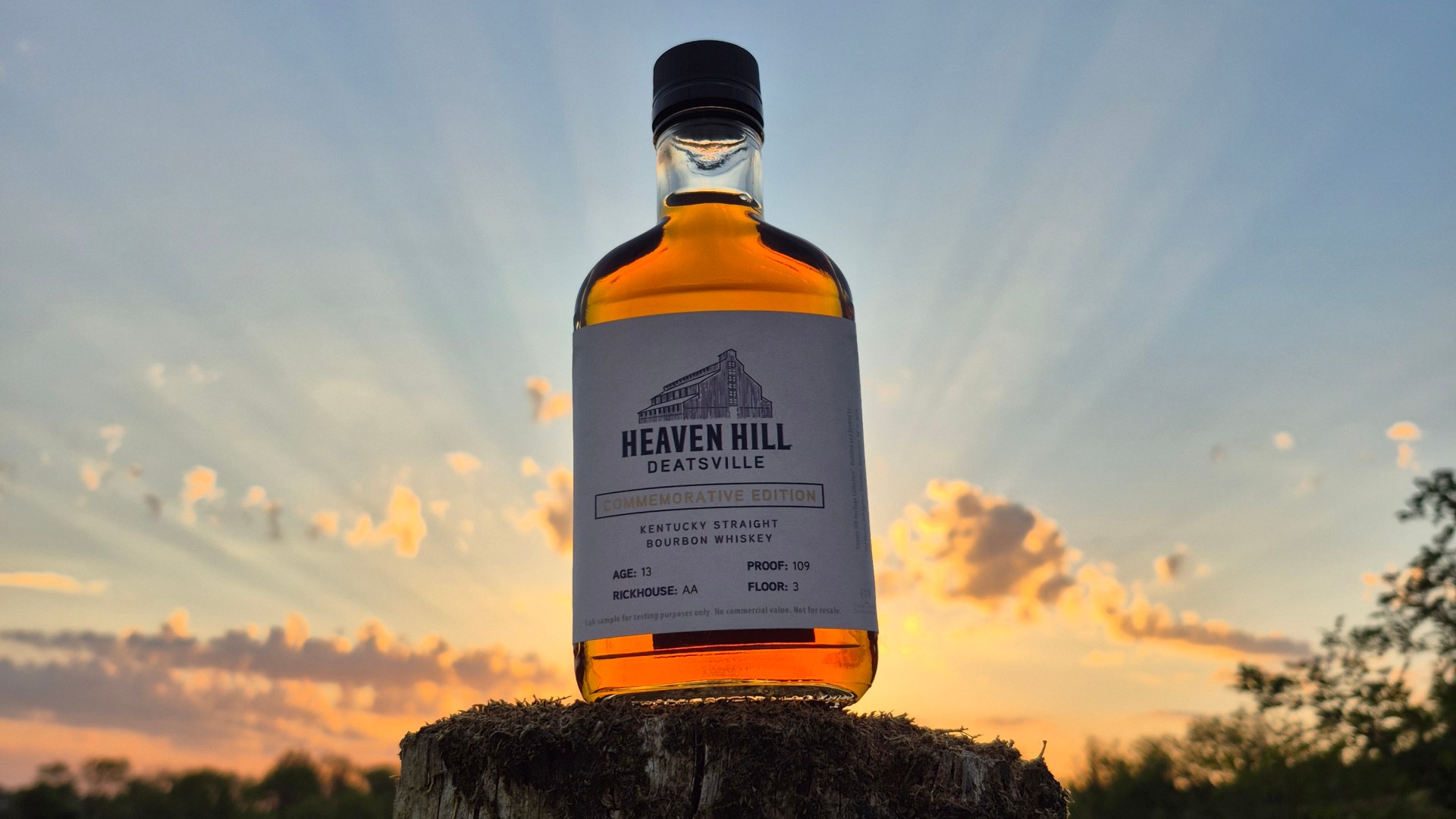
In February 2026, Heaven Hill Distillery announced the release of the Heaven Hill Deatsville Commemorative Edition 13-Year-Old Bourbon. According to the distillery’s official release documentation, this bottling marks the beginning of a multi-year series extending through 2027, intended to document the history of the Deatsville warehouse campus.
The Deatsville site, located in Nelson County, originally operated as the T.W. Samuels Distillery before Heaven Hill acquired the property in the 1980s. Heaven Hill has indicated that over the next 12 to 24 months, the nine remaining rickhouses at the Deatsville campus will transition to a “regauge-only” status, meaning no new barrels will be placed there for maturation. This commemorative series therefore represents some of the final stock to undergo full maturation at the site. Deatsville also holds a special reputation for its ageing magic with barrels from this location having been used in several of the distillery’s limited offerings, including the 7th and 11th editions of the Parker’s Heritage Collection.
Architecturally, the Deatsville rickhouses are distinguished from Heaven Hill’s other rickhouses by their unique tiered-roof design, which utilises natural convection and atmospheric pressure changes to drive air circulation through the rickhouses and over the barrels maturing inside. This airflow creates a specific microclimate that influences the rate of interaction between the spirit and the wood during seasonal temperature shifts as whiskey is pushed and pulled out of the barrel by the pressure inside the barrel as warm air expands and cold air contracts.
For this initial commemorative bottling, Heaven Hill have selected a batch of 17 barrels containing whiskey produced using the distillery’s standard bourbon mash bill of 78% corn, 10% rye, and 12% malted barley.
The single barrel we’ll be tasting today carries a 13-year age statement and was harvested from the third floor of Rickhouse AA. It has been bottled non-chill filtered at a strength of 109 proof (54.5% ABV).
Vital Stats:
Name: Heaven Hill Deatsville Commemorative Edition 13-Year-Old Bourbon
Age: 13 years old
Proof: 109 (54.5% abv)
Type: Kentucky Straight Bourbon Whiskey
Mashbill: 78% Corn, 10% Rye, 12% Malted Barley
Producer: Heaven Hill Distillery, KY
Website: https://heavenhilldistillery.com/
Glassware: Glencairn
Review
Nose: The nose opens bold and complex with dark caramels, concentrated (almost tart) stone fruits and cherries, a herbaceous charred oak edge, earthy baking spices, thick marzipan, and creamy vanilla. As you nose deeper, the profile becomes noticeably darker with dark chocolate developing alongside the herbaceous charred oak notes, whilst sweet caramels, fruits, earthy barrel spice and coffee linger around the edges.
Palate: The palate opens with medium viscosity and a concentrated but delicious bourbon profile of sweet dark caramels bordering on butterscotch, condensed, faintly sweet stone fruit and cherries, and marzipan greets you before a sharp and tannic herbaceous charred oak spice blooms on the mid palate. As you chew, this heat fades back, and a herbaceous charred oak profile emerges, bringing with it dark chocolate, a touch of earthy barrel spices, more red fruits, and a nearly savoury edge.
Finish: The finish opens with lingering dark chocolate-forward charred oak spice, dark caramels, mint-forward herbaceous notes, coffee, and dried cherries before a long, flavourful, and dry aftertaste of dark caramels and minty charred oak.
Overall
This is one of those bourbons where the flavours are so heavily concentrated that the first two sips feel nearly big and bumpy on the palate; however, once your palate acclimatises to it, you can appreciate the layers of flavour that build up on your tongue before the liquid opens up by the third sip and melts with unexpected softness.
The funny thing is that I tasted this blind before I’d looked at any of the paperwork or release information, and my immediate reaction was that it tasted like a Parker’s Heritage bourbon. It carries that exact same dark, brooding, and deeply complex profile, and it gives a dark herbaceous and charred oak character that reminds me of an old vintage dusty bourbon full of rich flavours and a near-butterscotch caramel sweetness. It is easy to taste why Parker Beam favoured these warehouses so much because putting a whiskey with this amount of concentrated oomph into a blend would easily carry through, even in a much larger batch.
Personally, I found the nose to be exceptional, and it offers the kind of depth where you could sit and smell the glass for 10 minutes between every sip as those dusty notes swirl through concentrated aromas of dark chocolate, marzipan, and coffee. Whilst there is a slight sharpness to how intensely herbaceous and charred the wood notes come through on both the nose and the palate, this intensity is beautifully buffered by the rest of the dense flavour as dark caramels, minty oak tannins, and dried stone fruits keep that sharp edge firmly in check so it never gets out of hand.
At 13 years old, this whiskey drinks like something far older and bolder, and it delivers the kind of exceptional depth, intensity, and lingering dry aftertaste that you normally only find in high-proof, straight-from-the-barrel releases. It carries its 109 proof remarkably well too, and I found it didn’t need any water at all to tame the heat. There is also this distinct and incredibly defined liquorice note that pops up continually from start to finish, and that really speaks to just how deeply the oak flavours have integrated over 13 long years on the third floor of Rickhouse AA. When I looked into why we were given the floor number for this release, I found that in a standard Kentucky rickhouse, the lower-to-middle floors typically yield a more tempered, slow-maturing profile because they sit below the intense heat of the roof. However, knowing these barrels sat on the third floor of a Deatsville rickhouse is important because it shows how the tiered-roof design pulled a constant convective draft upward, subjecting these lower barrels to an accelerated airflow dynamic that you simply don’t get in a conventional warehouse. Obviously there are far too many variables involved to say that one architectural feature alone created this flavour profile, but it may help explain why the whiskey developed such immense concentration without becoming completely over-oaked or drying the palate out.
In fact, given how dominant and concentrated the wood notes are, this feels like a bourbon that has extracted just about everything it could from the barrel. For some drinkers, it may even be approaching the upper edge of what they consider balanced. Personally, I think Heaven Hill got the timing right, and if they had allowed any longer, it could have started sacrificing some of the nuances that make it special. As it stands, there is still enough sweetness and fruit left in the tank to stop the wood from taking over completely.
As somebody who loves getting right down into the weeds of warehouse locations and barrel provenance and all the tiny variables that shape a whiskey over time, this sort of release is honestly right up my street, and it is just great to see. In the broader whiskey market, plenty of producers try to highlight their different warehouse variations, but Heaven Hill has a massive and very distinct advantage here because of their sheer scale. When you are managing an inventory of over two million barrels across more than 70 different warehouses, you have the luxury of choice that very few people can match, and they have the exact stock density they need to isolate an incredibly small 17-barrel batch that spent its entire life inside a singular architectural anomaly like the Deatsville tiered-roof structures. Smaller operations simply cannot replicate a hyper-specific flavour profile like this at 13 years old, and that is what makes it special. As the opening chapter of a series that will run all the way through 2027, and marking the historic campus’s transition out of active maturation into a regauge-only status, this release works as an incredible educational platform. It provides a really transparent, behind-the-curtain look at how structural design and natural airflow guide blending decisions and flavour development, which is the exact kind of deep-dive release I would love to see more distilleries attempt from a whiskey geek perspective, but more importantly, the liquid completely backs up the story, and it just speaks for itself.
Try or Buy
With a suggested retail price of $199.99, this release sits firmly within the premium allocated bracket where expectations are understandably going to be very high. The reality is that two hundred dollars is a significant ask for a 13 y.o. bourbon, and on paper, it might cause some initial hesitation, especially when excellent, older age-stated bottles from the same distillery can occasionally be found on the shelves for less. Plenty of drinkers will look at this and question whether the age statement alone justifies the price, but evaluating this whiskey purely through the lens of age misses much of what makes it so interesting. This isn’t simply a standard 13 y.o. Heaven Hill product, because you are paying for an unrepeatable snapshot of a maturation environment that is effectively disappearing. Drawn from a tiny 17-barrel batch from a historic warehouse campus that is permanently shutting down its active ageing operations, it captures a specific microclimate and a flavour profile that will become increasingly difficult, if not impossible, to ever recreate in the future.
That doesn’t automatically make it worth the money for everyone, though. If you are a casual drinker or someone who generally prefers a softer, sweeter bourbon with a more traditional and restrained oak influence, this is an absolute “Try” before you consider hunting down a full bottle. The profile here leans incredibly heavily into mature wood, herbal complexity, liquorice, and heavy charred oak tannins. While those dense characteristics are exactly what make the bourbon so compelling to me, they are definitely not designed for easy, crowd-pleasing sipping, and they could very easily overwhelm a palate that isn’t actively looking for a massive oak profile.
But for experienced enthusiasts, collectors of Heaven Hill history, or anyone who specifically seeks out the big, brooding, and tannic complexity of the Parker’s Heritage line, this lands firmly in “Buy” territory if you can find it at retail. The quality of the spirit completely justifies the entry fee, and given the retail price, it delivers a massive amount of depth and historical value for the money. More importantly, the whiskey itself completely earns that recommendation. If you were to strip away the story, the warehouse, and the commemorative packaging altogether, you would still be left with an outstanding bourbon. The Deatsville connection simply provides the context for understanding why the liquid in the glass tastes so distinctive, and in a market where limited releases often rely way more on artificial scarcity than actual quality, this is one of those rare examples where the whiskey actually lives up to the narrative surrounding it.


